Showing posts with label silver. Show all posts

Saturday, September 7, 2013

The object of the day: Victorian silver butter dish

A Victorian circular cut glass butter dish on a silver stand with a fitted silver lid embossed with a bead edge and scroll work decoration on a mat background. The base with a vacant oval cartouche, the domed lid with a quatrefoil multi-scroll handle.
Base 7 inch diameter, height 3.5 inches.
Made in Birmingham 1892 by B. J. Keyzor.

Estimated price:
£300.00

Silver containers for butter uncommon in 18th century, but small silver scallop-shaped dishes with glass liners, and sometimes ball feet, made from c 1725 in Britain, may have been butter dishes. Most 18th century examples Irish; shallow pierced bowl with glass liner and cover, sometimes feet. Also, glass bowl with silver saucer and cover. Sometimes found with cow finial.Type in vogue i early 19th century usually has stand, dish of silver or glass, and cover; other examples are straight-sided, oval, with cob and knob finial, four feet, and with handle at each end. Tub shape also was popular. The butter dishes were also made in Sheffield plate and electro-plate.

Thursday, July 19, 2012

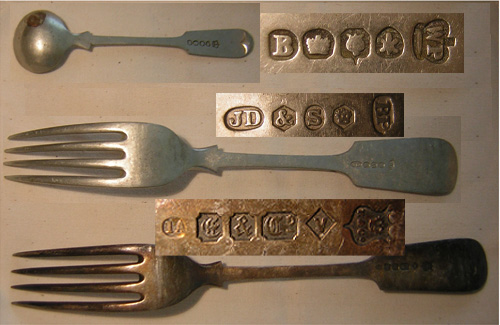
Standard British hallmarks

Great Britain operates the most rigorous system of hallmarking anywhere in the world. The first statute governing standards was passed in 1238, but the proper system came into operation with the introduction of the leopard's head mark in 1300, to be struck on both silver and gold throughout the realm. The standard set for coinage (92.5 %) was also used for silver objects. In 1363 a further statute was passed by which every gold and silversmith added his maker's mark to pieces (at this time in the form of symbols as few could read or write) to counteract the widespread practice of forging the leopard's head mark on substandard wares. in 1478, the third mark was added in the form of a letter. 


From this date all work had to be taken to Goldsmith's Hall for testing and marking by touchwardens (hence, Hall Marks). This was to stop gold and silversmith from bribing the touchwardens who had previously come to their workshop to do the testing and marking. Substandard wares had been marked, accepted by the Mint and converted directly into coinage which led to a loss of confidence in the currency. But with this third mark, originally called the Assay Master's mark, the Assay Master or touchwarden could be identified if a marked piece was found to be substandard.

Friday, March 9, 2012

Decoration techniques on antique silver

The type of decoration on a piece of silver can provide a good indication of its date, as styles varied in different periods. Pay special attention to the condition of the decoration as well as the overall condition of the piece as both have  a bearing on value. The main types of decoration are listed below:

Engraving

This is a technique of decorating surface of the silver from the front, removing the metal by incising lines, patterns and portraits. As far back as the 3rd millennium BC it was done with flint, bronze and copper tools. Today, it is achieved by hand with a sharply pointed steel tool held on an engraver's block, or by machine.


Wednesday, November 23, 2011

The object of the day: Silver stirrup cast in a shape of fox head

An exceptional cast stirrup cup realistically modelled as a fox head (London 1864)
George Fox (1860-1895) / Charles Thomas (worked from 1860)
Medium
Silver
Dimensions:
4.75 inch deep (12.06 cm)
Diameter
2.50inch diameter ( 6.35 cm)
Price
GBP 14 500.00 (Pound Sterling)

Wednesday, November 16, 2011

Designer: Omar Ramsden

Omar Ramsden (1873-1939)

English silversmith born in Sheffield. He spent some years in Illinois, USA, before being apprenticed to a firm of silversmiths back in Sheffield. In 1890 he attended evening classes at the Sheffield School of Art where he met Alwyn Charles Elison Carr and then both had summer classes at the Royal College of Art. Ramsden specialised in the design of silver and gold presentation and ceremonial pieces, including plates, wine cups and masers.

His design is associated with Art Nouveau.

They set up a studio together in Chelsea in 1898 and shortly after moved the workshop to Fulham. Ramsden had the public relations flair while Carr provided the financial backing. The partnership was dissolved in 1919. Ramsden had up to 20 assistants working for him during the 1930's but he never worked on a piece himself.
Related Posts Plugin for WordPress, Blogger...