Showing posts with label antique silver. Show all posts

Thursday, January 16, 2014

The object of the day: Caddy spoon by Omar Ramsden

Omar Ramsden caddy spoons were used to measure tea leaves from the caddy to the teapot. This spoon, by Omar Ramsden and Alwyn Charles Ellison Carr, has a planished finish and central red enamelled panel. The price is estimated GBP 1,200 - 1,800. 

The work of Omar Ramsden has become highly desirable in recent years. He produced high-quality re-interpretations of Tudor and Celtic silver, metalwork and jewellery, often featuring hand-hammered finishes, enamels and applied decoration. Ramsden operated a small workshop from 1898 - 1919 in partnership with Alwyn Carr, and went on to register his own mark in 1919.

His workshops produced a large volume of ecclesiastical, civic and corporate work in the Art Nouveau and Art & Crafts styles. He produced numerous presentation pieces and private commissions. His works often have the engraved inscription 'Omar Ramsden Me Fecit' ('Omar Ramsden made me').


Thursday, November 21, 2013

The object of the day: Silver & ivory Victorian launching axe

Rare silver & ivory Victorian launching axe (1873 London)
Barnard Brothers, London (1830-c.1910)

Medium
Silver and ivory

Signed/Inscribed/Dated 1873 and 1879

Dimensions 6.00cm wide 20.20cm high 1.90cm deep
 
Condition Excellent, original condition.

Monday, September 23, 2013

Kovsch: Antique Russian ladle

Kovsch is Russian drinking ladle with boat-shaped body and short flat handle, it may be shaped like a water bird or a Viking ship. Made from Middle Ages to the end of the 17th century in silver. base metal or wood. Originally the Kovsh made from wood and used to serve and drink mead, with specimens excavated from as early as the tenth century. Generally made in sets: smaller one engrave with Imperial eagle and name of the owner; larger used only on ceremonial occasions and passed among guests.

A Russian silver gilt and enamel kovsch maker's mark Fedor Ruckert, Moscow, 1908 - 1917 of typical form, decorated in colours with stylised geometric, foliate and floriate designs, impressed marks to base. Length 16 cm.
After c. 1650, awarded for services rendered to state. Revived in 19th century, usually for decorative purposes; richly ornamented with enamels.

Friday, June 7, 2013

Collecting tips for antique cutlery collectors


As well as checking for worn tines on forks, check the bowls of spoons for sign of wear. A worn bowl will have an angled, almost cut-off appearance. The rounded-bowl soup spoon didn’t come into being until c 1900, so what we call a tablespoon actually started life as a soup spoon. 

Set of 5 pieces of odd silver plated cutlery including 2 Christofle spoons

Wednesday, June 5, 2013

Antique silver candlesticks


We take the convenience of electric light so much for granted that it is easy to forget how dependent our ancestors were on candlelight. The earliest surviving silver candlesticks werer made solely for ecclesiastical use, as it was only the church who could afford such luxuries. Early candles were both smoky and smelly, made from beewax or tallow, with those made in France considered far superior to the English variety. 


Victorian Silver Candlesticks
A pretty pair of antique sterling silver candle holders with stepped square bases and Corinthian tops. The columns are decorated with trailing harebells. Height 16 cms. Base 8 x 8 cms. London 1892. Maker Martin, Hall & Co.
Price £765

Saturday, August 11, 2012

Reed & Barton antique silverware


Reed & Barton are known for their quality silverware. They started in 1824 in Taunton, Massachusetts, when under the name of Babbitt & Crossman they began making a type of base metal also known as pewter or Brittania (which was used to create the Oscar statuette). They later specialized on silver plated pieces and this was well before changing their name to Reed & Barton in 1840.   


Reed & Barton were well established as Silverware production company by the end of 1840s selling a large number of their silver plated pieces, including trays, bowls and pitchers to Rogers Brothers in Connecticut that in turn placed the now famous hallmarks on those items. At the same time, they were involved in the production of weapons for the Union Army soldiers and officers in American Civil War along with a growing range of silver plated products, many of them depicting animals such as dogs, cats, horses and sheep by the turn of the century. 

Thursday, July 19, 2012

Standard British hallmarks

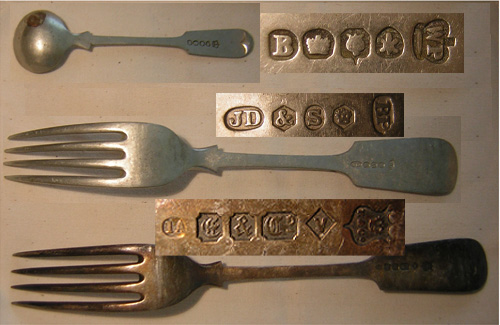
Great Britain operates the most rigorous system of hallmarking anywhere in the world. The first statute governing standards was passed in 1238, but the proper system came into operation with the introduction of the leopard's head mark in 1300, to be struck on both silver and gold throughout the realm. The standard set for coinage (92.5 %) was also used for silver objects. In 1363 a further statute was passed by which every gold and silversmith added his maker's mark to pieces (at this time in the form of symbols as few could read or write) to counteract the widespread practice of forging the leopard's head mark on substandard wares. in 1478, the third mark was added in the form of a letter. 


From this date all work had to be taken to Goldsmith's Hall for testing and marking by touchwardens (hence, Hall Marks). This was to stop gold and silversmith from bribing the touchwardens who had previously come to their workshop to do the testing and marking. Substandard wares had been marked, accepted by the Mint and converted directly into coinage which led to a loss of confidence in the currency. But with this third mark, originally called the Assay Master's mark, the Assay Master or touchwarden could be identified if a marked piece was found to be substandard.
Related Posts Plugin for WordPress, Blogger...